

When people hear the word editing, they often think it simply means fixing spelling mistakes. But editing is much bigger than that.
In simple words, editing means improving a piece of writing, video, image, or content to make it clearer, better, and more professional.
Whether you are writing a blog, creating a YouTube video, preparing an assignment, or designing a social media post — editing is what turns “okay” content into something that looks polished and high-quality.
In this guide, you’ll learn the complete editing definition, types of editing, real examples, and why editing is so important.
Editing Definition (Simple Meaning)
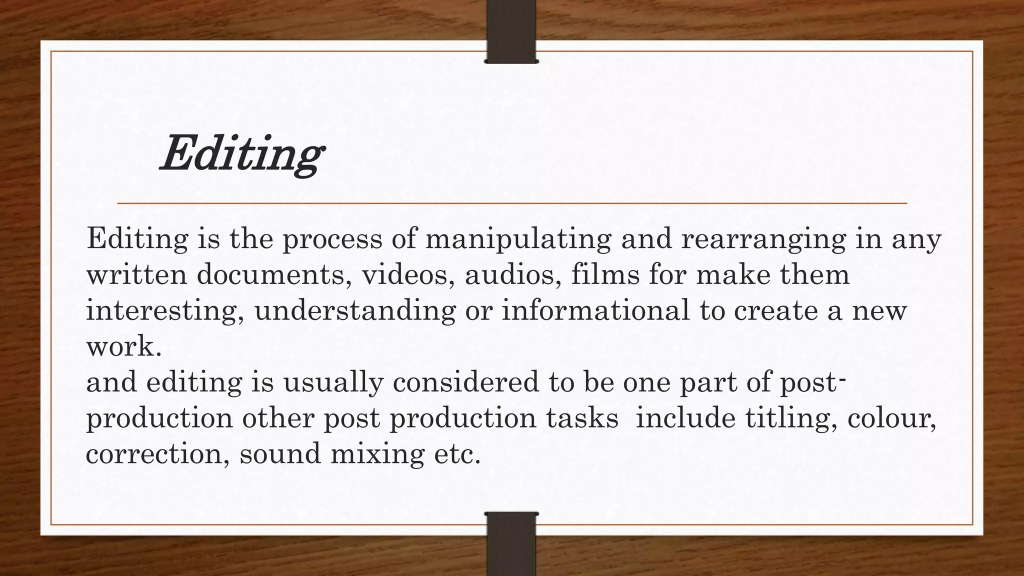
Editing is the process of reviewing and changing content to improve its quality, clarity, accuracy, and overall presentation.
Editing can include:
- Fixing grammar and spelling
- Improving sentence structure
- Removing unnecessary words
- Making ideas clearer
- Correcting facts
- Improving flow and readability
- Enhancing design or visuals
So yes — editing is not just correcting mistakes. It is about making the content better and easier to understand.
What Is Editing in Writing?
In writing, editing means checking your content and improving it so that:
- Your message is clear
- The tone is correct
- The writing looks professional
- The reader can understand easily
For example:
❌ Before Editing:
“I want to write a blog which help peoples and its very important.”
✅ After Editing:
“I want to write a blog that helps people, and it is very important.”
See the difference?
The meaning is the same, but the second sentence looks clean, correct, and professional.
What Is Editing in Simple Words?
Here’s the easiest way to understand it:
Editing means making something better by checking it carefully and fixing errors.
It’s like cleaning your room before guests arrive.
The room is already there — but you organize it, remove mess, and make it look good.
You may also like it:
Vlog Video Editing Tips For Stunning YouTube Vlogs
How To Download YouTube Videos In PC | Full Guide
Vlog Editing Guide: Tips, Tools, Benefits & Drawbacks
Why Editing Is Important
Editing matters because it helps you:
1. Improve Quality
Even good content can look weak without editing.
2. Make Content Clear
Editing removes confusion and improves understanding.
3. Remove Mistakes
Grammar errors, wrong punctuation, and spelling mistakes reduce trust.
4. Improve Professionalism
Edited work looks more serious and polished.
5. Increase Engagement
People stay longer on content that is easy to read and well-structured.
Types of Editing (Complete List)
Editing has different levels. Let’s understand the most common types.
1. Proofreading
Proofreading is the final step of editing.
It focuses on:
- Spelling mistakes
- Punctuation errors
- Grammar issues
- Typos
Example:
- “teh” → “the”
- “Its” → “It’s”
2. Copy Editing
Copy editing improves writing style and correctness.
It includes:
- Grammar improvement
- Sentence structure
- Consistency (dates, names, formatting)
- Word choice
This type of editing is common in blogs, newspapers, and books.
3. Line Editing
Line editing focuses on improving sentences line by line.
It improves:
- Tone
- Flow
- Readability
- Clarity
Line editing makes the writing sound smooth and natural.
4. Developmental Editing
This is the deep level of editing.
It focuses on:
- Structure
- Content organization
- Logical flow
- Missing details
- Weak arguments
This is often used in:
- Books
- Research papers
- Long articles
5. Content Editing
Content editing focuses on the message and meaning.
It checks:
- If the content is helpful
- If ideas are explained properly
- If information is accurate
- If anything is missing
Editing vs Proofreading (Main Difference)
Many people confuse these two.
| Feature | Editing | Proofreading |
| Focus | Improve content + structure | Fix final small mistakes |
| Includes | Clarity, flow, tone, grammar | Spelling, punctuation, typos |
| Stage | Before final version | After final version |
Editing improves writing. Proofreading polishes it.
Editing Examples (Easy to Understand)
Here are some simple editing examples:
Example 1: Grammar Fix
❌ “She don’t like coffee.”
✅ “She doesn’t like coffee.”
Example 2: Clarity Improvement
❌ “The meeting was done by him.”
✅ “He conducted the meeting.”
Example 3: Removing Extra Words
❌ “In my personal opinion, I think…”
✅ “I think…”
Editing in Different Fields
Editing is not only for writing. It exists in many areas.
1. Video Editing
Video editing means:
- Cutting unnecessary clips
- Adding transitions
- Adding subtitles
- Improving sound quality
- Adjusting colors
2. Photo Editing
Photo editing means:
- Adjusting brightness
- Removing background
- Enhancing colors
- Fixing blur
- Retouching
3. Audio Editing
Audio editing includes:
- Removing noise
- Fixing voice levels
- Cutting silent parts
- Adding effects
4. Editing in Academic Work
In assignments and research, editing helps:
- Remove grammar mistakes
- Improve structure
- Make arguments stronger
- Ensure proper formatting (APA, MLA, Harvard)
Editing Process (Step-by-Step)
If you want to edit your work properly, follow these steps:
Step 1: Take a Break
After writing, take a short break. It helps you notice mistakes easily.
Step 2: Read Your Work Slowly
Read it like a reader, not like a writer.
Step 3: Fix Big Issues First
Check:
- Are ideas clear?
- Is the structure correct?
- Are paragraphs in the right order?
Step 4: Improve Sentences
Make sentences:
- shorter
- clearer
- smoother
Step 5: Proofread
Finally, check:
- spelling
- punctuation
- grammar
- typos
Best Editing Tips for Beginners
If you are new to editing, these tips will help a lot:
- Use simple words
- Avoid long sentences
- Remove repeated ideas
- Use headings and bullet points
- Check facts and numbers
- Read your content aloud
Use tools like Grammarly (optional)
Common Editing Mistakes to Avoid
Many people make these mistakes while editing:
- Editing too quickly
- Ignoring structure and flow
- Only focusing on spelling
- Over-editing and removing natural tone
- Not checking readability
Editing should improve your content, not destroy your style.
Final Thoughts: Editing Definition Explained Clearly
Now you know the complete editing definition.
Editing is the process of improving content by making it clearer, correct, and professional. It is used in writing, videos, photos, audio, and academic work.
If you want your work to look high-quality and trusted, editing is not optional — it is necessary.
FAQs for “Editing Definition” (SEO-Friendly)
1. What is the definition of editing?
Editing is the process of reviewing and improving content by fixing mistakes, improving clarity, and making the work more professional and easy to understand.
2. What is editing in simple words?
In simple words, editing means making something better by correcting errors and improving the overall quality.
3. What are the main types of editing?
The main types of editing include proofreading, copy editing, line editing, content editing, and developmental editing.
4. What is the difference between editing and proofreading?
Editing improves content, structure, clarity, and flow, while proofreading focuses on final small mistakes like spelling, punctuation, and grammar errors.
5. Why is editing important in writing?
Editing is important because it improves readability, removes mistakes, strengthens the message, and makes writing look professional and trustworthy.
